
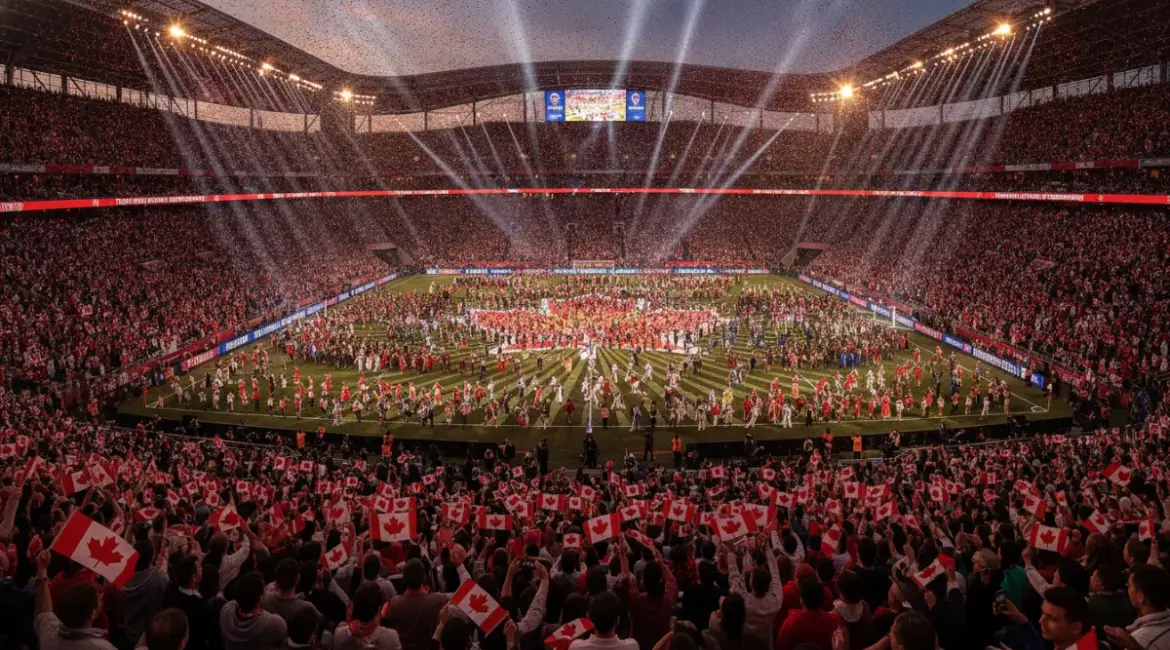
The 2026 FIFA World Cup opens with a landmark moment for Canada: its first time helping launch the tournament on home soil. The event starts this week across Canada, the United States, and Mexico, with the competition running from June 11 to the final on July 19 in New York.
That makes this edition the largest World Cup ever staged, with a record 104 matches spread across 16 host cities. For Canadian fans, the biggest story is not just that the tournament is here, but that one of its most symbolic moments is taking place in Toronto.
Toronto takes center stage
Canada’s opening ceremony will be held at Toronto Stadium on June 12 at 1:30 p.m. local time, which is 17:30 GMT. The show is built around the idea of a cultural mosaic, and organizers say it will spotlight the country’s diversity through music, movement, and visual storytelling.
The program is expected to last about 13 minutes and open with a countdown that carries viewers “from coast to coast to coast.” The phrase fits the occasion well: this is Canada’s first World Cup opening ceremony, and it is designed to feel unmistakably national.
Performers are expected to include:
- Alanis Morissette
- Alessia Cara
- Jessie Reyez
- Michael Bublé
- William Prince
- Elyanna
- Nora Fatehi
- Sanjoy
- Vegedream
FIFA President Gianni Infantino described the ceremony as “a powerful reflection of Canada’s identity,” calling it a moment of pride, unity, and anticipation as the country steps fully onto the world stage.
A milestone for Canadian soccer
The ceremony leads directly into a game that Canadian supporters have been waiting years to see. After the celebration ends, Canada’s men’s national team will play Bosnia and Herzegovina, marking the country’s first World Cup match ever on home soil.
Kickoff is scheduled for 3 p.m. local time, or 19:00 GMT, after the usual pre-match warm-ups and introductions. The setting gives the team a rare chance to begin a World Cup campaign in front of a home crowd, with Toronto expected to provide a strong and energetic atmosphere.
For a program that has continued to build momentum in recent years, the symbolism matters almost as much as the result. The match represents both a sporting test and a public debut in one of the biggest events in global sport.
One tournament, three opening celebrations
Canada’s show is part of a connected three-country opening sequence. Mexico begins the tournament on June 11, Canada follows on June 12, and the United States also stages its ceremony on June 12. All three events share the same larger message: football can link different cultures, languages, and national traditions in one global celebration.
The ceremonies are being produced by Marco Balich, whose resume includes major Olympic opening shows. Each host nation is presenting a different visual identity, but the timing and purpose are aligned.
Here is the basic structure of the opening day celebrations:
- Mexico City opens the tournament first, 90 minutes before Mexico plays South Africa.
- Toronto follows with Canada’s ceremony 90 minutes before the host team’s match.
- Los Angeles closes the North American launch with the United States before its game against Paraguay.
Mexico’s event takes place at Mexico City Stadium, formerly known as Estadio Azteca, and is the longest of the three at roughly 16 and a half minutes. It is expected to feature Indigenous performers, folkloric elements, and artists such as Shakira, Alejandro Fernández, J Balvin, Maná, and Tyla. Authorities in the capital have declared June 11 a public holiday, closed schools, and encouraged remote work.
The U.S. ceremony, staged later on June 12 at Los Angeles Stadium, is scheduled to include Katy Perry, Future, Anitta, LISA, Rema, and Tyla.
What viewers in Canada need to know
Canadian audiences can watch the opening ceremonies and matches on CTV and TSN, with French-language coverage on RDS. In the United States, coverage is split across FOX, FS1, and the free streaming service Tubi, while viewers in the United Kingdom can follow the action on the BBC and ITV.
The staggered schedule means fans can follow the tournament launch in stages, beginning with Mexico on June 11 and continuing with the Canadian and American openers on June 12. That creates a full opening stretch instead of a single ceremony, which fits the scale of this World Cup.
Toronto prepares for the crowd
Toronto organizers are expecting heavy foot traffic around the stadium and are adding transit service to help move spectators more efficiently. Security and logistics remain central priorities, not only in Canada but across all three host nations.
Elsewhere, preparations have had some complications. In Mexico City, teachers’ union protests have raised concerns about possible road disruptions near the stadium, although officials say the ceremony is still on track and a major security presence is in place. In Los Angeles, planners have focused on crowd control and have said they do not expect immigration enforcement at World Cup venues.
For Canada, the bigger picture is simpler: a national first, a home crowd, and a tournament launch that will be remembered for years. When the team walks out in Toronto, the event will reflect the country’s diversity in the stands as much as on the field.