
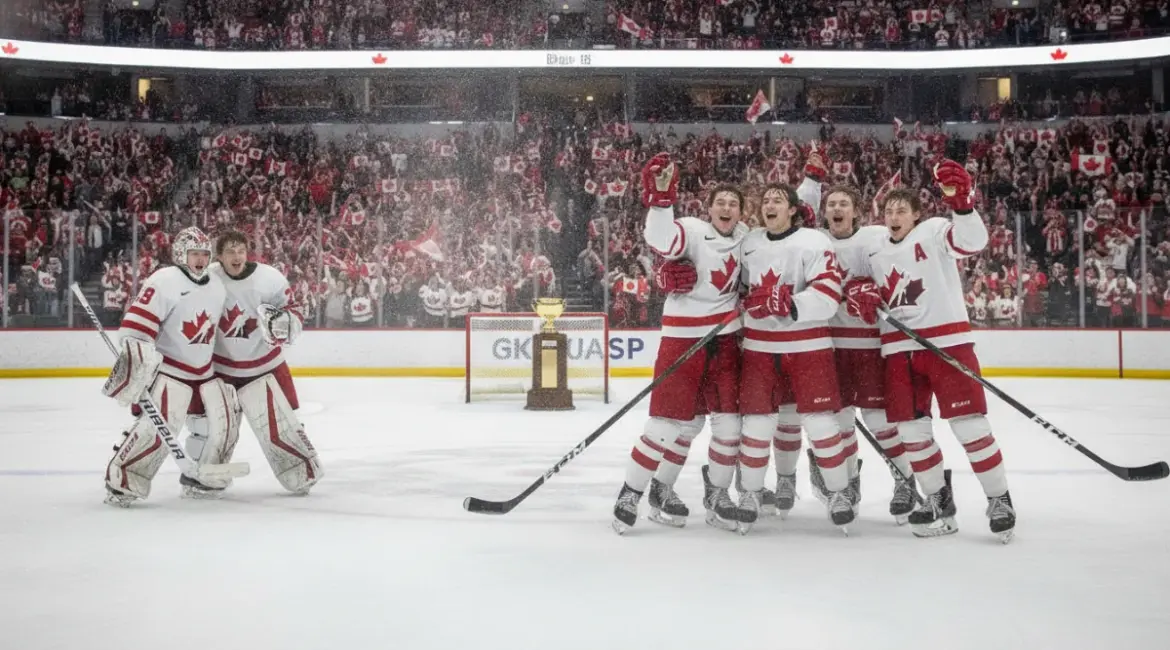
Canada is one win from the championship game after rolling through the preliminary round in Edmonton. The host team now faces Finland in Friday’s semifinal at Rogers Place, with the United States or Slovakia waiting on the other side of the bracket.
The Canadians arrive in the knockout stage with momentum, confidence, and a perfect record. They outscored Switzerland, Slovakia, and Sweden by a combined 20-8, and that kind of production has made them one of the most dangerous teams in the tournament.
Here is a clear look at Canada’s path, the schedule, the possible final opponent, and the players most likely to shape the semifinal.
Semifinal timing and gold-medal schedule
Canada and Finland meet on Friday, August 7, 2026, in Edmonton.
The semifinal begins at 5 p.m. Mountain Time, which is 7 p.m. Eastern Time, 4 p.m. Pacific Time, 8 p.m. Atlantic Time, and 8:30 p.m. Newfoundland Time. The winner moves into Saturday’s final, while the loser drops into the bronze-medal game.
The championship game is set for Saturday, August 8, also at Rogers Place. Puck drop for the gold-medal matchup is 5 p.m. Mountain Time, with the bronze game scheduled earlier in the day at noon Mountain Time. TSN and RDS are carrying the games from Rogers Place throughout the event.
For viewers planning ahead, the schedule can be read as a simple sequence of decisions:
- Canada plays Finland in the semifinal.
- The winner earns a place in the gold-medal game.
- The loser plays for bronze.
- The title game follows on Saturday night in Edmonton.
How the bracket sets up Canada’s next challenge
Canada’s reward for winning Group A is a semifinal against Finland, which finished second in Group B behind the United States. The other semifinal sends the Americans against Slovakia at noon Mountain Time on Friday, and that result will determine the final opponent for the Canadian side.
A meeting with the United States would create a matchup between two unbeaten teams. The Americans also went 3-0 in the preliminary round, beating Czechia, Finland, and Germany while allowing only six goals and scoring 18. They return to the decisive game as the defending champion after taking the 2025 title.
A matchup with Slovakia would offer a rematch from the group stage. Canada handled Slovakia 6-1 earlier in the tournament, with Kayden Stroeder scoring twice in a game that secured first place in the group. Even so, Slovakia still presents a threat because forward Tomas Selic led all players in preliminary-round scoring with eight points, including five goals and three assists.
| Possible final opponent | What stands out | Why it matters |
|---|---|---|
| United States | Unbeaten, defending champion, strong defensive record | Would create a top-tier North American final |
| Slovakia | Already lost to Canada in group play, but still has top scorer Tomas Selic | Would bring a familiar opponent with one dangerous offensive leader |
Canada cannot look past Finland, but the bracket does make the stakes easy to understand: win Friday, and a gold-medal shot follows less than 24 hours later.
Players and trends that could decide the semifinal
Canada’s biggest edge has been depth. Four players sat among the tournament’s top seven scorers after the preliminary round, which shows how difficult the team is to defend for a full 60 minutes.
Maddox Schultz led the Canadian attack with seven points, all while creating chances rather than just finishing them. Liam Pue followed closely with six points and entered the semifinal as Canada’s top goal scorer with four, including a two-goal outing against Switzerland. Stroeder matched Pue’s six-point total and added balance to the forward group with three goals and three assists. Ryerson Edgar also chipped in with five points, another sign that the offense is spread across multiple lines.
The defense has contributed, too. Landon DuPont, Jaakko Wycisk, Brock Cripps, and Alexis Joseph have all added multiple points from the back end, which helps Canada transition quickly and keeps pressure on opposing penalty kills. DuPont, in particular, has drawn attention as one of the tournament’s most closely watched prospects. The Everett Silvertips defender recorded a goal and two assists in the opening three games and continues to play an important role on the power play and in puck movement out of Canada’s zone. He also brings meaningful experience, having been the only player on the 2026 roster who earned bronze at the 2025 Hlinka Gretzky Cup.
Leif Oaten gives Canada another important layer. The Canadian goaltender posted a 2.50 goals-against average in the preliminary round, and he may not need to face a huge workload, but the semifinal could still turn on a few key saves if Finland stays close.
Canada’s preliminary-round results came in this order:
- A 7-3 win over Switzerland, highlighted by two goals each from Liam Pue and Brock England.
- A 6-1 win over Slovakia, powered by a two-goal performance from Kayden Stroeder.
- A 7-4 win over Sweden, built on a five-goal first period and 49 total shots.
Those games showed a team that can score early, score often, and recover when the opponent pushes back. The issue now is whether that same approach can survive Finland’s structure.
What Canada must handle against Finland
Finland earned its semifinal place by taking two of three preliminary-round games. It opened with a 5-2 comeback win over Germany, then lost 4-1 to the United States, and finished by edging Czechia 5-4.
Goaltender Samu Heikkinen is likely to be central to the contest. He stopped 38 shots against Czechia and entered the semifinal with a .922 save percentage, which ranked third among goaltenders after the preliminary round. If he sees the puck well early, Canada may have to work harder than it did in group play to create separation.
The Canadian plan should be straightforward: stay disciplined, keep the puck moving, and force Finland to defend for long stretches. Sweden found openings when Canada’s focus slipped in the third game, and that is the type of mistake that could change a semifinal. Finland is comfortable waiting for turnovers and turning them into quick attacks, so loose puck management in the neutral zone would be a problem.
Canada also needs to generate quality, not just quantity. A volume-shot approach can work when a team is outgunned, but Heikkinen has already shown that he can absorb heavy pressure. Screens, rebounds, and second chances should matter more than point shots from distance.
Finland will not likely outshoot Canada, yet it does not need to. If the game stays tight, one counterattack or one special-teams swing could decide the result. That makes the opening period especially important for the hosts, who would benefit from an early lead and a cleaner pace.
Canada entered the tournament chasing a record-setting 26th summer under-18 gold medal, and the road to that milestone now comes down to one test. If the hosts beat Finland, they will have a shot at gold on Saturday night in front of their home crowd.