
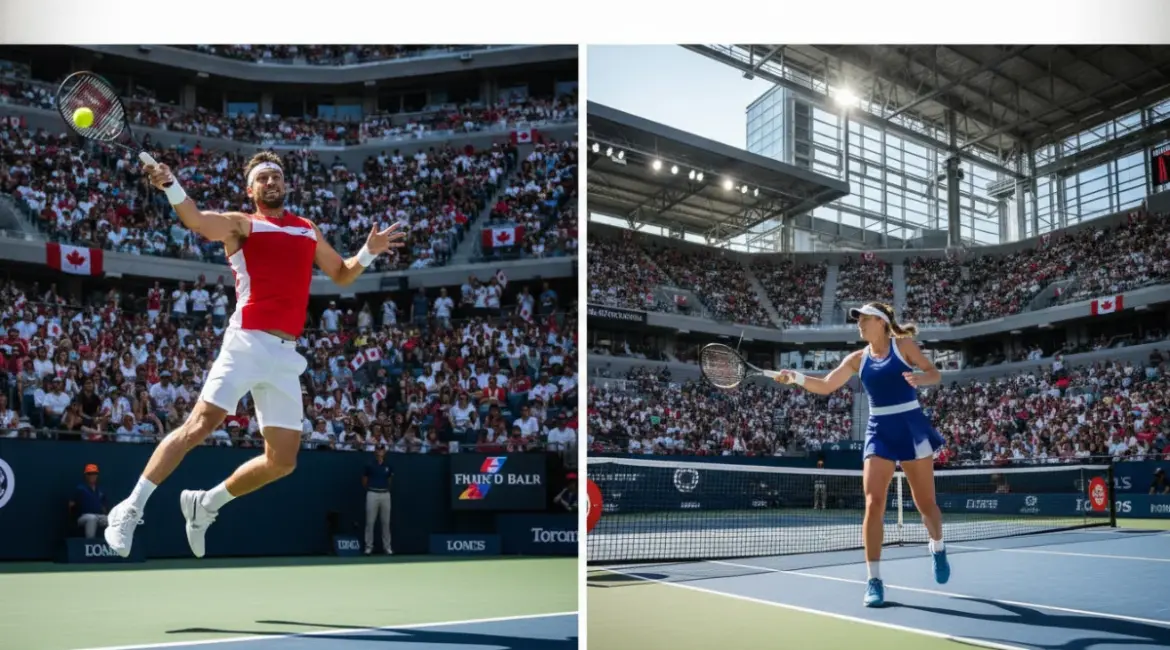
The National Bank Open’s round of 16 arrives with major stakes in both Canadian host cities. Montreal’s men’s event has turned unpredictable, while Toronto’s women’s draw still features most of the leading names.
By the time the weekend closes, only eight players will be left in each singles bracket. That makes Saturday and Sunday the most revealing days of the tournament so far.
How the Round of 16 is set up
The next phase is scheduled for Saturday, August 8, and Sunday, August 9, 2026. Montreal and Toronto will each stage four singles matches per day, with the winners moving on to the quarterfinals on Monday, August 10, and Tuesday, August 11.
At IGA Stadium in Montreal, daytime sessions begin at 12:30 p.m., and evening play starts at 6 p.m.. In Toronto, the equivalent start times are 12:30 p.m. for the day session and 7 p.m. at night.
Because match times can shift based on length and weather, the final order of play is usually confirmed the day before each session. That means fans should check the schedule before heading to the stadium or tuning in from home.
| City | Venue | Day Session | Evening Session | Round of 16 Dates |
|---|---|---|---|---|
| Montreal | IGA Stadium | 12:30 p.m. | 6 p.m. | August 8-9 |
| Toronto | Center Court at the National Bank Open | 12:30 p.m. | 7 p.m. | August 8-9 |
Montreal’s men’s bracket has opened up
The men’s field has already been shaken by a string of early exits. Alexander Zverev, Daniil Medvedev, Taylor Fritz, and Andrey Rublev all left before the tournament reached the round of 16, and Félix Auger-Aliassime withdrew with a back injury. Six of the top 10 seeds were gone before the second round ended.
That kind of collapse changes the entire feel of the draw. Instead of a straightforward path for the favorites, Montreal now looks wide open for players who can keep their level steady for one more week.
Ben Shelton is among the names that immediately stand out. The defending champion opened with a 6-3, 7-5 win over Jenson Brooksby, and his serve-plus-power style is well suited to fast hard courts.
Casper Ruud also enters the week in strong position. He beat Juan Manuel Cerúndolo 6-1, 6-2 in his first match, and although hard courts are not his most famous surface, he has enough experience to take advantage of the opening left by the top seeds.
What Shelton, Ruud, and the younger challengers are chasing
Shelton’s title defense now carries a different kind of pressure. Winning the 2025 edition gave him his first Masters 1000 trophy, and a repeat would show that last year was not a one-off run.
His challenge is not just the opposition. He also has to manage the stretches where his attack becomes too aggressive and errors pile up. If he keeps those moments under control, the path ahead looks more manageable than it did at the start of the week.
The upside of the draw is just as important for the younger players. João Fonseca has already delivered one of the most notable results by defeating Stefanos Tsitsipas, while Arthur Fils advanced after a three-set win over Zachary Svajda.
Tallon Griekspoor is another player who has used the upset-filled environment to his advantage. His comeback victory over Zverev, 6-7, 6-2, 6-4, showed both resilience and confidence at a moment when the bracket was beginning to crack open.
Those results create a clear roadmap for how the rest of the men’s draw may unfold:
- Keep pressure on the remaining seeded players.
- Use the faster court conditions to shorten points.
- Turn one big upset into a deeper run.
That formula has already worked once in Montreal, and the next round will show whether it can work again.
Toronto keeps its biggest names in place
The women’s event has been steadier, with the top contenders mostly holding form. Aryna Sabalenka, Elena Rybakina, Jessica Pegula, Coco Gauff, and Mirra Andreeva all advanced through their opening matches and remain central figures in Toronto.
Sabalenka is still the player everyone is chasing. She began with a 6-3, 6-3 win over Moyuka Uchijima, extending her hard-court winning streak to 13 matches. Her serve and first-strike power remain especially dangerous on Toronto’s courts.
Rybakina had a more demanding start. She needed three sets to get past Daria Kasatkina, finishing with a 6-3, 5-7, 6-4 victory after more than two and a half hours. The match showed both her greatest strength and her most obvious risk: when her timing is right, she can overpower almost anyone, but her error count can rise quickly.
Gauff, Pegula, Andreeva, and Fernandez add intrigue
Coco Gauff opened with a 6-2, 7-5 win over qualifier Kayla Day. She did not dominate every exchange, but her speed and defensive balance helped her finish the important points when it mattered most.
Jessica Pegula also had to work for it. After dropping the first set against Magdalena Frech, she regrouped and closed out a 3-6, 6-3, 6-1 win by taking eight of the last nine games. Her past success in Canada gives her extra credibility in these conditions.
Mirra Andreeva may have delivered the most complete performance of the group. She beat former world No. 1 Karolina Pliskova 6-0, 6-2 in just 54 minutes, showing the kind of court awareness and calm decision-making that have become her trademarks at only 19 years old.
For Canadian fans, the spotlight now belongs to Leylah Fernandez. She defeated Renata Zarazúa 6-2, 6-2 and became the last home player left in either singles draw. The next test is Elise Mertens, a veteran who can stretch rallies and make opponents solve problems point by point.
Fernandez will need to stay aggressive, especially early in points. When she takes time away from her opponents and plays with conviction, she can still force even the strongest players into uncomfortable positions.
How to follow the weekend
Canadian viewers can watch the tournament on Sportsnet and TVA Sports, the official broadcasters of the National Bank Open. Their coverage also extends through digital platforms, which is useful when session times shift.
For anyone tracking both draws, the weekend should provide the clearest answer yet about who is truly built for a deep run. Montreal has become a test of survival, while Toronto is starting to look like a battle among proven contenders.
In Montreal, Shelton, Ruud, Fonseca, Fils, and Griekspoor all have real chances to push farther than expected. In Toronto, Sabalenka, Rybakina, Pegula, Gauff, and Andreeva remain the names most likely to control the late rounds.
For the home crowd, Fernandez offers the strongest reason to keep watching. If she can keep winning, the tournament will still have a Canadian storyline heading into the quarterfinals.