
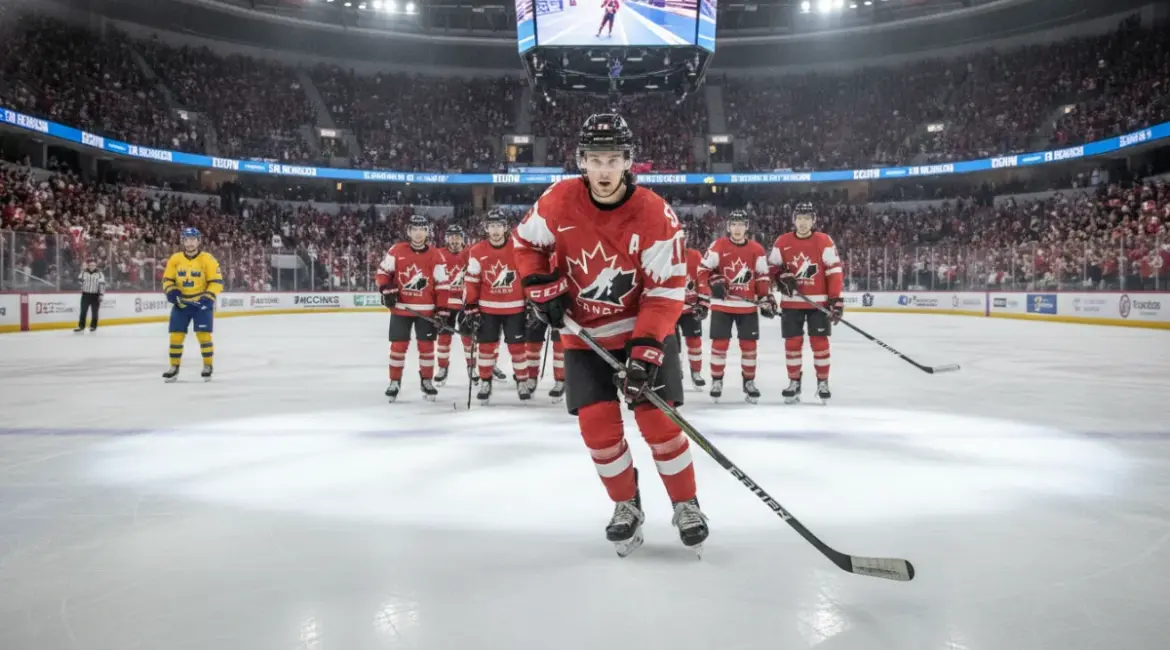
Canada has already punched its ticket to the semifinals, but the bigger prize at the Hlinka Gretzky Cup is still out in front. After two convincing wins to open group play, the Canadians now turn their attention to Sweden and then to the knockout stage, where the margin for error disappears.
The final preliminary game arrives Wednesday, August 5, at Rogers Place in Edmonton, with Canada facing Sweden at 5 p.m. Mountain Time and 7 p.m. Eastern Time. The result will not change Canada’s place in Group A, but it will still matter as the last tune-up before the games become do-or-die.
A fast start has put Canada in control
Canada entered the tournament with the kind of start coaches hope for in a short event. The team opened with a 7-3 win over Switzerland, then followed that with a 6-1 defeat of Slovakia. Those back-to-back victories gave Canada six points, first place in Group A, and an early sense that this roster can score in waves.
The opener against Switzerland was especially striking because Canada did its damage quickly. Five goals in the first period set the tone, and the final shot count showed how much pressure Canada sustained throughout the night. Liam Pue scored twice, while Brock England, Camryn Warren, Ryerson Edgar, and Benjamin Veitch each added a goal. England later finished the game with a short-handed marker in the third period, a sign that Canada’s pace and confidence carried over even when the situation changed.
The next game against Slovakia looked even more complete. Kayden Stroeder scored twice, Landon DuPont joined the scoring, and Warren, Edgar, and Pue all found the net again. Canada also controlled the shot volume by a wide margin, and Leif Oaten handled the limited work he received in goal by turning aside 12 of 13 shots. The overall picture through two games is clear: Canada is not relying on one star line or one breakthrough performance. The goals have been spread around, and the defense has been active enough to keep the attack alive.
That balance matters in a tournament like this. In a short competition, a team can survive a quiet night from a top scorer only if other players are ready to step in. Canada has already shown that kind of depth, and that may be its most important advantage heading into the elimination rounds.
Sweden brings a different kind of pressure
Canada’s meeting with Sweden is less about survival and more about sharpening details. Sweden still has something to play for in the standings, which changes the emotional weight of the game. The Swedes started by edging Slovakia 4-3, then dropped a high-scoring 7-6 decision against Switzerland. That leaves them needing a stronger finish against Canada if they want to solidify their semifinal hopes.
There is also a useful layer of familiarity. Canada already beat Sweden 3-1 in a pre-tournament meeting, but the group-stage version should carry a different feel entirely. Warm-up games are useful for measuring shape and chemistry, yet they do not replicate the pressure of a game that sits right before the medal round. Sweden’s offense has shown enough firepower to make the matchup interesting, especially with Dorian Eklund Aspe producing four points and Oliver Sundberg and Milan Sundstrom each scoring twice across the first two games.
For Canada, this is a chance to stay sharp without the burden of needing points to advance. That freedom can be useful. A coach can test pairings, manage ice time, and watch how players respond when the pace tightens. Ryan Oulahen, who helped guide Canada during its 2024 title run in Edmonton and is now the head coach, has the opportunity to treat the game as both a challenge and a final rehearsal. The goal is not only to win, but also to arrive at the semifinal with the right tempo, habits, and energy.
That matters because knockout hockey is different. The space shrinks, the hits arrive sooner, and mistakes become harder to recover from. A group-stage win is nice; a playoff win requires a team to keep its discipline even when the game becomes less forgiving.
The medal path is clear, but the opponent is not
By finishing first in Group A, Canada will meet the second-place team from Group B in Friday’s semifinal. The other semifinal will pair the Group B winner with the runner-up from Group A. The winners move on to the gold-medal game on Saturday, August 8, while the losers meet for bronze.
At the moment, Canada’s possible semifinal opponent remains unsettled. The United States sat in first place in Group B after two games, while Czechia and Finland were tied behind them with three points apiece. Germany had yet to earn a point. Until the remaining preliminary games are completed, Canada will not know which team stands in the way of the final.
That uncertainty does not reduce the difficulty ahead. In fact, it may increase the emphasis on preparation. A semifinal in this event is not just another hockey game; it is the point where a strong week can become a memorable tournament or end abruptly. Canada learned that lesson last year, when it went undefeated in the preliminary round before falling 4-3 to the United States in a semifinal shootout. The Canadians then recovered to beat Finland for bronze, but the chance at gold was gone.
That result still offers a useful reminder. Dominant group play can create momentum, but it does not protect a team once the bracket starts to decide everything in a single game. Canada’s current form is encouraging, yet the real test begins when the margin for recovery disappears.
The bigger picture also raises the stakes. Canada has won 25 of the 34 summer under-18 gold medals awarded since the tournament began in 1991, and the program has built long runs of success over multiple eras. It captured seven straight titles from 1996 through 2002 and then eight in a row from 2008 through 2015. That history creates a standard that follows every Canadian roster into this event.
The expectations rise again when the tournament is staged in Alberta. Before this year, Canada had won gold in all three previous Alberta-hosted editions, including the 2024 championship in Edmonton, where it beat Czechia 2-1 at Rogers Place. Another title would extend that province-wide perfect record and add a 26th summer under-18 championship to Canada’s résumé.
For many fans, the appeal goes beyond the medal chase. The Hlinka Gretzky Cup is one of the earliest major stages for players entering their NHL draft years, which makes it one of the best places to see future talent in a high-pressure setting. DuPont has drawn attention as one of the most closely watched names on the roster, but the early games have also brought Pue, Edgar, Warren, Schultz, and Stroeder into the spotlight. In the semifinal, all of them will face the first true elimination test of their international careers at this level.
Canada has already done the hardest part of the preliminary round by securing first place, and the tone around the team is understandably upbeat. Still, the next phase will reveal whether this roster can turn offensive depth, home-ice energy, and strong early chemistry into the kind of complete tournament run that ends with gold. Friday will show whether the opening surge was only a strong start or the foundation of something bigger.