
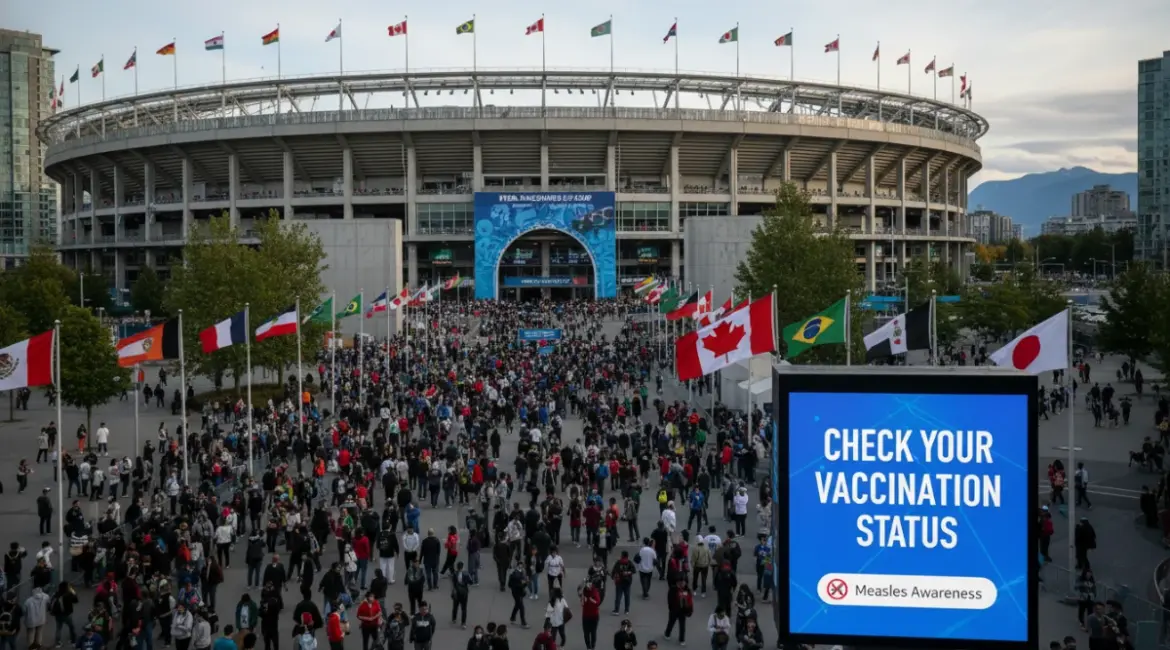
Health officials are urging caution as Vancouver prepares to welcome a surge of international visitors for next month’s FIFA World Cup. The concern is not the event itself, but what can travel with it: measles, one of the most contagious diseases known, could arrive with fans, athletes, and support staff from multiple countries.
The Public Health Agency of Canada has flagged measles as a likely importation risk during the tournament. That warning is grounded in three realities. Measles is still circulating in many parts of the world, it spreads through the air with unusual ease, and major sporting events create dense, fast-moving crowds in airports, hotels, transit systems, and stadiums.
Ontario has already released a public infectious disease risk assessment for the World Cup. That report points to international travel, crowded venues, and weaker vaccination coverage as factors that could help an imported case turn into a broader outbreak. British Columbia has not yet published a public version of its own assessment.
Why Public Health Leaders Want Faster Communication
Dr. Brian Conway, medical director of the Vancouver Infectious Diseases Centre, says that silence from provincial health officials is a problem at this stage. In his view, residents need clear reminders before the crowds arrive, and visitors should know that Canada is dealing with active measles transmission right now.
He argues that the message should be practical and direct. People should check whether they are protected, confirm their vaccination history, and update their records if they are missing doses. That advice matters most when thousands of travelers are about to enter the same city at the same time.
Conway’s concern is not alarmism. It is a reminder that prevention works best before exposure happens, not after cases begin appearing in emergency rooms and public health offices.
How the Current Outbreak Changes the Picture
Canada has already recorded more than 900 measles cases across seven jurisdictions this year, with Alberta and Manitoba accounting for a large share. The country is still dealing with the fallout from a much larger surge last year, when more than 5,000 people were infected. That outbreak is believed to have started with an imported case in New Brunswick in fall 2024.
British Columbia has also seen substantial activity. Provincial data show 470 measles cases reported during 2025 and 2026, and about 80 percent of them have been concentrated in northeastern B.C., where immunization rates are among the lowest in the province.
That pattern matters because measles does not need much help to spread. A single case in the wrong setting can cause a long chain of exposure if enough people nearby are not immune.
Vancouver’s Past Offers a Useful Warning
Public health experts are looking back at Vancouver’s recent history for context. After the 2010 Winter Olympic Games, British Columbia experienced a measles outbreak that included 82 confirmed cases. The circumstances were different, but the lesson is similar: major international events can create ideal conditions for infectious diseases to move quickly.
Dr. Conway says the current risk may be even more complicated because vaccination rates have dropped in some parts of British Columbia. He also notes that some of the countries sending visitors to the World Cup may have lower immunization coverage than Canada, which raises the chance that an infected traveler could arrive without knowing it.
In that kind of environment, an imported case is not just a medical issue. It becomes a public planning issue that affects schools, clinics, transit hubs, and event venues.
What Local Agencies Say They Are Ready to Do
Vancouver Coastal Health says it has been preparing for the FIFA World Cup for several years and has completed a public health risk assessment with the B.C. Centre for Disease Control. The assessment has not been made public, but Dr. Mark Lysyshyn, the agency’s deputy chief medical health officer, said the measles risk for the tournament was rated in the medium or moderate range.
He also said the region has already managed dozens of imported measles cases during the current outbreak without seeing sustained local spread. According to Lysyshyn, that record reflects strong immunization coverage across much of the Vancouver Coastal Health region.
In his view, a case brought in during the World Cup would not necessarily be harder to contain than other imported cases the system has already handled. Still, he emphasized that public health teams are watching closely and preparing for the possibility of new exposures.
- Review vaccination records before traveling or attending crowded events.
- Make sure any missing measles doses are updated in time.
- Seek medical advice quickly if symptoms appear after exposure or travel.
- Follow local public health guidance if a case is identified nearby.
Who Faces the Greatest Risk
Dr. Monika Naus, a professor at the University of British Columbia’s School of Population and Public Health, says that all large international gatherings carry some infectious disease risk. Even so, she believes the broader risk to the general public remains limited because most adults are already protected through vaccination or prior infection.
The main concern, she says, is not the average person standing in line at an event. It is what happens if measles reaches a community where vaccination levels are already low. In British Columbia, those communities are often clustered geographically, which can make outbreaks more likely to build quickly once they begin.
That is why experts keep returning to the same point: the strongest protection is already available, but it depends on people knowing their status and acting on it before exposure occurs.
Why the Vaccine Status Question Matters Now
Canada lost its measles elimination status last year after the Pan American Health Organization informed the country that sustained transmission had continued too long. A country can only maintain elimination status when cases are limited to isolated importations rather than ongoing spread. Canada can recover that status if transmission is interrupted for a full year.
That makes the weeks before the World Cup especially important. With packed stadiums and international travel expected to bring even more people into Vancouver, health officials are hoping prevention efforts will stay ahead of the virus.
Measles is highly contagious, but it is also vaccine-preventable. For residents and visitors alike, confirming immunity is one of the simplest ways to reduce the chance that a global sports celebration turns into a local public health problem.